


From the introduction:
page 3:
The world’s myths are based on the stars and heavenly cycles, and they are speaking an esoteric and
allegorical language. This fact, which by now should be indisputable based on the overwhelming
volume of evidence, argues that the ancient stories are not based on terrestrial history, characters, or
events. They are not about external persons living thousands of years ago, or events external to our
lives which happened to someone else in lands now buried under the sands of time. The ancient
myths are based on the stars because the myths are describing an infinite realm – the realm of spirit,
the realm of the gods – and the things they are describing apply directly to our own lives. The sacred
stories, as Alvin Boyd Kuhn once explained, are about us – and they are not grasped in their “full
force and applicability” unless and until each man and woman encountering those myths discerns
himself or herself to be, as Kuhn puts it, the central figure in them!
From a discussion of the story of Rabbit Boy, related by Jenny Leading Cloud of the White River
Sioux in 1967, and recounted in American Indian Myths and Legends, edited by Richard Erdoes
and Alfonso Ortiz:
page 139:
Both the great turning-point at the winter solstice and the grinding-out of precession over the course
of millennia deal with related themes. The Ages-long motion of precession causes the “dislocation”
of the background of stars, and can be seen as representative of our own “dislocation” during this
incarnate life, in which we find ourselves “dismembered” – divided from our own identity, our
conscious mind separated from our subconscious mind, alienated from our spiritual nature, out of
touch with our Higher Self (and dubious even of the existence and reality of the Higher Self). No
wonder precessional figures such as Osiris, Dionysus, and Rabbit Boy are cut or torn to pieces in
the ancient myths!
But at the same time, these figures all transcend their own dismemberment, ultimately rising again
in triumph. Associated with the constellation Ophiuchus, they are positioned near the point of the
year’s great upward turn, after reaching the lowest point of winter solstice. This turning point,
sometimes described as a “second birth,” is necessitated by the first condition – our dislocation and
“dismemberment.”
The story of Rabbit Boy, then, is about us: it describes our own condition in this incarnate life. As
Alvin Boyd Kuhn wrote in 1936, ancient myth depicts “the drama of our history here and now; and
it is not apprehended in its full force and applicability until every reader discerns himself [or herself]
to be the central figure in it!”
From the chapter entitled “Star Myths of Ancient India”:
page 629:
One reason to suspect a possible association with Ophiuchus for Krishna is the fact that Krishna is
almost invariably depicted as holding his flute out to one side as he plays it, not straight out from his
mouth the way the “pipe” emerges from the mouth of Bootes in the outline of that constellation.
This manner of holding the flute suggests that the “tail-end” of the serpent held by Ophiuchus, the
eastern half which is located on the left side of the body as we face the star-chart below, plays the flute of Krishna:
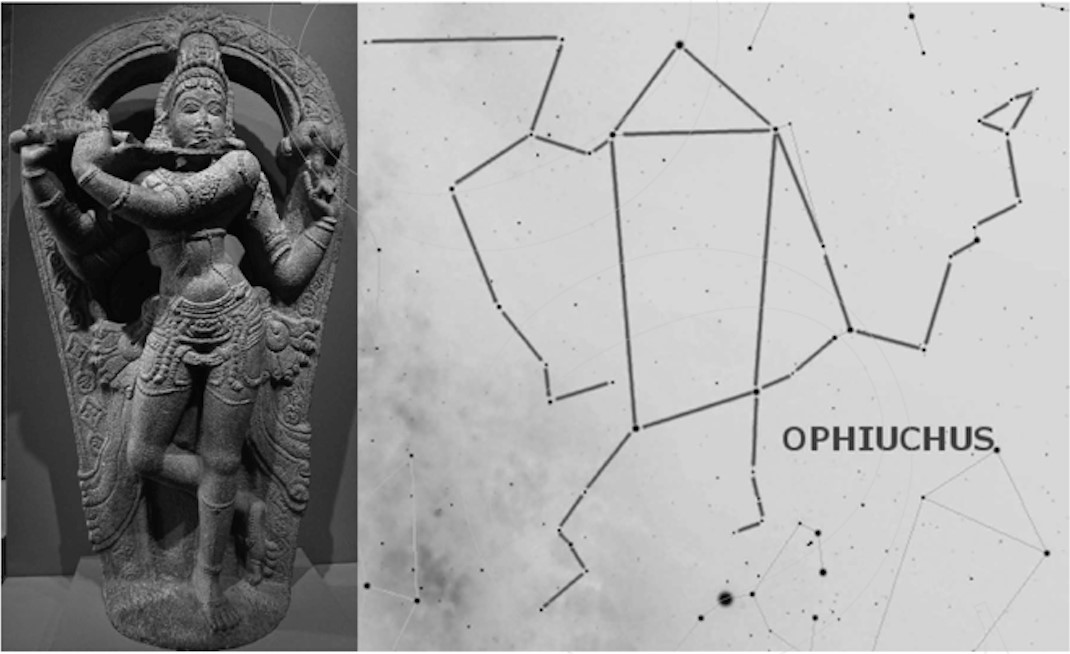
In the image above, which juxtaposes a star-chart of Ophiuchus with a 15th-century sculpture of the
god, we can see how the left half of the serpent of Ophiuchus, as outlined by H. A. Rey, could be
envisioned as resembling a flute held sideways.
[Page 630:]
Indeed, in that sculpture, the artist has depicted two arms of Krishna holding the flute, extending to
the left as we face the sculpture, but has added a third arm extending to the other side of Krishna’s
body (to the right as we face the image) which almost perfectly mirrors the other half of the serpent
of Ophiuchus, on the right side of the central body as we face the star-chart above. This “third arm”
depicted in the sculpture is holding some kind of weapon or other object which is strongly suggestive
of a connection to the “serpent-head” on the right side of the body of Ophiuchus as we face the starchart.
