
- Home
- Editor's Notes
- Current Issue
- Riki Reflects
- Spiritual Traveler
- Starz Emporium
- Classifieds
- Advertise with Us
- Submissions
- Awards
- About Us
- Contact Us



The Sacred Biodiversity Oracle
By Angela Manno
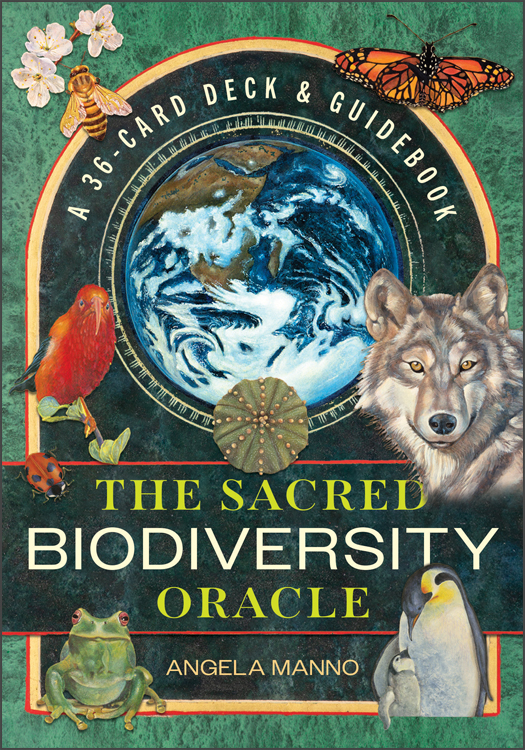 Instructions and Overview Use of this book and cards is designed to inform, stimulate the emotions, evoke empathy, and move the reader to action. To begin, shuffle the deck, pull the card or cards that feel right, and refer to the species’ corresponding section in this booklet. Each of these sections includes the following four parts: Wisdom This is the discursive component. This first step asks us to turn our awareness to the species you have selected (or that has selected you) and begin to learn about it: its habitat, special traits, role within the larger ecosystem, how its health affects the health and well-being of the ecosystems of which it is an integral part, and its plight. Understanding another (whether the other be human or nonhuman) prepares us for the emergence of compassion and further, stimulates a desire in us to alleviate another’s suffering. In the Buddhist tradition, attention is the first stage in mindfulness meditation. As the poet Mary Oliver wrote “Attention is the beginning of devotion.” This component also reveals how the fate and condition of each species affects the health and well-being of human beings—both existentially as well as spiritually. Contemplation This component stimulates our intuitive sensibilities and inner knowing. Whereas in many Western practices the focus is on listening and the Word, the Eastern spiritual practices often tend to focus on gazing and the Image. This engages the right side of the brain, eliciting an experience beyond discursive knowledge. We can share imaginatively in the life of the being upon which we gaze. Through this exercise, we are sensitized and cultivate our capacity for empathy. ✧ Visio Divina ✧ Visio Divina, or sacred seeing, is an ancient form of prayer and meditation. Follow these steps to enter deeply into the essence of the depicted species and what it might be telling you. 1. Select a quiet place for this exercise. Take three deep breaths. 2. Begin to gaze softly upon the image on your chosen card. What shapes, details, and colors do you notice? What feelings arise? 3. Meditate on the aspect of the image that most deeply speaks to you. Is there a message that pertains to your life today? Sit with and dwell on the thoughts, feelings, and sensations that are evoked. Reflection Reflection is intended to integrate our discursive knowledge and intuitive experience. Journaling and automatic writing are suggested ways to engage on this level. While journaling is a common practice, automatic writing is less widely known but can open the door to even more intuitive knowledge. This is also known as stream of consciousness writing. The instructions under this heading will guide you through the process. You will need to have a notebook handy. Action Action is the final and crowning component of the whole process. Knowing and caring must lead to action on behalf of the living world, for as it is said, untested virtue is no virtue at all. All the world’s religions have a concept of repairing or improving the world. To name a few: the Hebrew concept of tikkun olam, meaning “world repair”; the Quaker project of building the Peaceable Kingdom and Heaven on Earth; Engaged Buddhism, which focuses on peace, social justice, hospice, and increasingly on environmental justice; American Indians’ role as caretakers of the Earth; and the Maori concept of guardianship, maintaining a nourishing rapport with the Natural World and reestablishing harmony with Creation through ceremony. Many successful social movements and non-violent direct action (NVDA) campaigns have been based first and foremost in understanding, contemplation, and compassion, such as abolition and the civil rights move-ments.* Now we are afforded the opportunity to use this time-honored approach to stop and reverse biodiversity collapse and species extinction. Scanning the QR codes and going to the websites of the conservation organizations, chosen especially for the important work they are doing to protect, preserve, rescue, rehabilitate, advocate, and lobby for these species and their habitats will offer a wealth of information and opportunities to take meaningful action. After perusing the website, decide how you will help—donate, volunteer, contact your representatives, educate, engage in non-violent direct action, and/or commit to a lifestyle change that will benefit your chosen species and the biodiversity of our planet. To keep up the momentum and help you carry out your intentions, write down your ideas. Create an action plan that includes each action step and the dates by which you will complete your chosen objectives. Further, see yourself joyfully engaged in this new role, perhaps joining with others in this worthiest of missions. Together our actions have the greatest power and potential. ✧ Group Exercise ✧ You may also perform these exercises with a group of people. Sit in a circle and spread out the cards face down. Then, each person picks a card at random. When everyone has a card, each person should proceed in silence through the Wisdom (suggested time: 2–3 minutes), Contemplation (3–5 minutes), and Reflection (8 minutes) of their chosen species. When you have finished all three exercises, raise your hand, and when everyone has done so, the group will know it’s time to move on. When everyone has finished, each person may speak in turn out of the silence. Feel free to express whatever is rising in you. You may want to share what you have learned about the plight of the species you’ve encountered; how its predicament impacts your life; and any emotions that arise, including concern, shock, grief, alarm, love, and compassion. Remember that your responses will help stimulate and open others’ understanding, compassion, and empathy as well. As there is no moderator, consider placing a talking stick or another object in the center of the circle. When a person is ready to speak, they pick up the object, speak, and, when finished, lay it down so that the next person may take the object when they are ready. Make sure to leave enough time between each person’s sharing so others can absorb what they have heard. In this part of the process, there should be no cross talk. This “listening spirituality” is a practice among the Religious Society of Friends (Quakers) as they listen for messages in prayer. It is also part of the practice of Dharma Sharing in the Plum Village tradition of Thich Nhat Hanh. We are not only listening to the beings we are contemplating and to our own intuition, but to the wisdom of each other as we engage in this part of the process. Once everyone who would like to share has spoken, go back into the silence and scan the QR code on your card. Read the messages on the landing page of the corresponding website and take some notes about how you might like to help the particular animal. When everyone has finished this last step, it might be a good time for the group to enter into conversation, to share revelations, excitement, new commitments that may be arising, resources, and to ask for or offer advice, give solace, and perhaps even enter into new partnerships. Whether you are working alone or in a group, it is likely that this process will stimulate strong emotions. This is the intent. Emotions (from the Latin e-movere) move us to action. They prepare you for the next step, which is action. It’s been said that Work is love in action. The “work” here is what Thomas Berry refers to as The Great Work of Our Time: We all have our particular work… But besides the particular work we do, and the particular lives we lead, we have a Great Work that everyone is involved in and no one is exempt from. The Great Work before us is the task of moving modern industrial civilization from its present devastating influence on the Earth to a more benign mode of presence. It is not a role we have chosen… We were chosen by some power beyond ourselves for this historic task… We are, as it were, thrown into existence with a challenge and a role that is beyond any personal choice. The nobility of our lives, however, depends upon the manner in which we come to understand and fulfill our assigned role. The Sacred Biodiversity Oracle by Angela Manno, published by Inner Traditions International and Bear & Company, © 2026. All rights reserved. http://www.Innertraditions.com Reprinted with permission of publisher. Author Bio: Angela Manno trained with a master iconographer from Russia and studied at the San Francisco Art Institute, Parsons School of Design, and l’Ecole des Arts in Lacoste, France, through Sarah Lawrence College. Her work has been exhibited in private and public collections around the world, including NASA, the Smithsonian’s National Air and Space Museum, and the National Museum of Women in the Arts. She works with the Center for Biological Diversity on its endangered species programs and lives in New York City. https://angelamanno.com |
Share this article with friends!
 |
Copyright © 1998 - 2026 Mystic Living Today All rights, including copyright, in the content of these Mystic Living Today web pages are owned or controlled for these purposes by Planet Starz, Inc. Terms of Service Disclaimer and Legal Information For questions or comment, contact Starzcast@mysticlivingtoday.com. Reproduction of this page in any form is not allowed without permission of the author and the owner of this site. All material on this web site, including text, photographs, graphics, code and/or software, are protected by international copyright and trademark laws. Unauthorized use is not permitted. You may not modify, copy, reproduce, republish, upload, post, transmit or distribute, in any manner, the material on this web site. Unless permissions is granted. |