
- Home
- Editor's Notes
- Current Issue
- Riki Reflects
- Spiritual Traveler
- Starz Emporium
- Classifieds
- Advertise with Us
- Submissions
- Awards
- About Us
- Contact Us



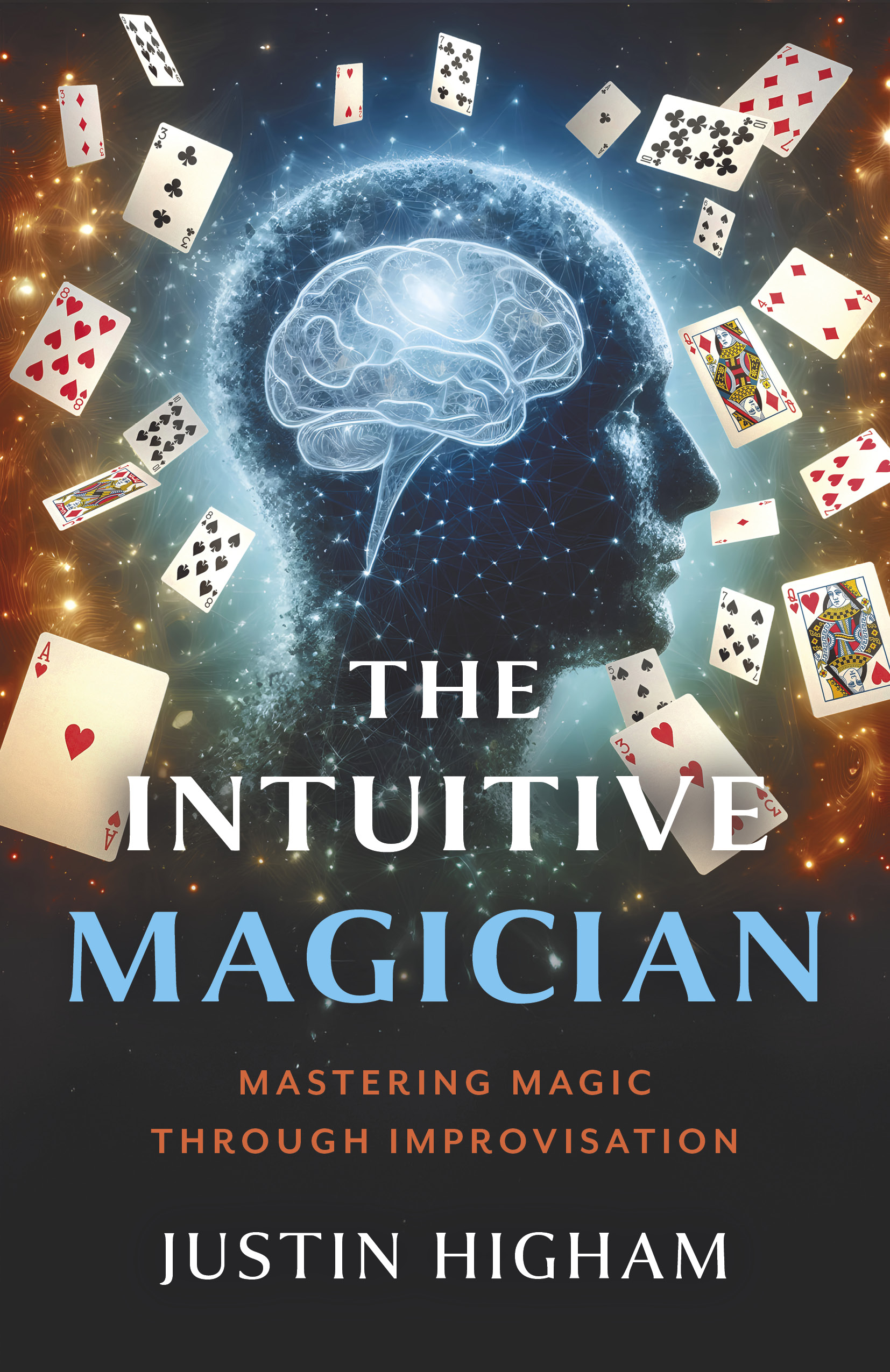
The Intuitive Magician
By Justin Highman
 Training the Subconscious Radar
Justin Higham (Adapted from The Intuitive Magician, pp. 419–427) We have all missed opportunities in life, from parking spaces to potentially life-changing events. We may not notice them in time or register their significance; or we do both, but hesitate through fear or some conflicting element. Many opportunities are hidden in plain sight. How much of life do we miss, not through fear of failure, but visual or psychological blind spots and plain ignorance? Missed opportunities may be as much to do with the way that we include certain stimuli as block out other stimuli. We see a parking space over the road, missing a better one right next to us. Anxiety can play a role in false positives: the less anxious we are, the better our exploiting of opportunities may be. Whatever our field or speciality, as we gain information, knowledge, skill, and experience, patterns emerge that were previously unperceived or disregarded. We can train ourselves to become aware of these patterns: not to go looking for them, which is self-defeating, but recognise when they appear unexpectedly. The skill is being able to spot new and unfamiliar opportunities as well as those involving recurring patterns. Indeed, it may be that unfamiliar opportunities belong to less common or broader patterns. How is such a skill developed? The beginning of the process is studying the phenomenon, both in the context of one’s own field and in general life; and in particular noticing when an opportunity has just occurred and mentally noting the experience and context, so as to become familiar with how the process feels (i.e., don’t over-analyse, because then you lose the sense of feel). Part of this learning is understanding that we can’t make these things happen, at least not directly; we cannot induce a butterfly to land on our fingertip, so to speak. We have to forget all about the process to have a chance of experiencing when it happens, and whatever is being manifested. Any tension in searching for something specific makes us miss what is right in front of us. What faculty is it that helps us spot opportunities indirectly? In simple language it could be described as a form of mental radar. The purpose of training such a radar is for opportunities to not just become visible, but appear larger and more vibrantly than they might otherwise be, allowing us to really notice and use them. It is not a case of shining a light in a certain direction or going looking for something, but making sure that the light is fully operational, like training a dog to sense certain scents. But what exactly is a mental radar? It is a verifiable process that can be experienced inwardly. While it is difficult to pinpoint precisely, in a similar way to trying to define consciousness, there are related phenomena that operate around its periphery or highlight facets of it. These are fairly well known and the reader may recognise some of them. Frequency Illusion: Denise Winn (The Manipulated Mind, 1983, p. 42) asks, ‘Why is it, for instance, that if we buy a new car or a new coat, we are so often aware that a great many other people also have the same model or style?’ The answer is not necessarily that the item is fashionable and so lots of people have it (which may be the case), because it occurs in a multitude of ways. Let’s say that you live in London or any large city and you’ve gone on an Italian-language course. All of a sudden you start noticing lots of people around London speaking Italian. Posters for Italian exhibitions, concerts, and food markets start popping up everywhere. Of course, there aren’t suddenly more Italian-speakers or events in London. They were there all along, but you were previously asleep to them; they were off your radar. A pattern is starting to emerge based on the ‘dog having become trained to certain scents’. There is a part of the brain that lights up, as it were, which previously would have remained inactive, because anything Italian would not have triggered it, due to its unrelatedness to you and your preoccupation with other patterns (what Denise Winn and other psychologists refer to as our perceptual set). These preoccupations help us make sense of an infinitely variable world, but they are both our liberator (due to the necessity of limitation) and inhibitor in that they block other patterns. The ‘noticing’ phenomenon has been referred to by Arnold M. Zwicky (‘Why Are We so Illuded?’, Stanford University, September 2006) as the frequency illusion. But there appears to be more to it than simply noticing or picking up on patterns. Some have referred to it through the Zen idea of ‘whatever you focus on becomes your reality’, referred to somewhat less poetically by some as ‘cosmic ordering’. Your body language or demeanour, mood, and thoughts influence the experiences you have and what kind of stimuli you are exposed to, and what stimuli exposes you to it. In conversation with a friend while walking down a street once, I idly pointed out that certain dropped till receipts looked like five-pound notes. A few minutes later, as we carried on walking, my eyes alighted upon something on the ground a few feet away: a folded five-pound note. The conversation had planted the idea in the subconscious, and the mental radar was on the lookout. It would have been easy to miss the folded banknote amongst all the litter without this priming factor. In the past two decades there has been a craze of people around the world reporting that, for no reason at all, while going about their business, they see the number 911 everywhere: a clock says 9:11, their bank balance is £911 or a serial number is 911. All manner of symbolism has been read into this, but it is nothing more than the number 911, being a significant number in many people’s minds for the past 20-plus years, causing our eyes to reflexively look at clocks or other displays when this number shows. But as mentioned, there is something beyond just happening to notice things more because of familiarity or significance. Subconscious programming or conditioning may be causing us to unknowingly be on the lookout for these patterns; they are almost magnetically pulling us towards them; hence the weird coincidence of the five-pound note. Reticular Activating System and Sensory Gating: The frequency illusion is only part of the faculty at work, in that new or unfamiliar patterns (which may be part of broader or more general patterns) may get flagged up by our noticing mechanism. How is it that certain information is noticed while other stimuli isn’t, or we become trained to spot certain patterns? The Reticular Activating System (RAS) may play a key role. Raúl Hernández-Peón et al. (‘Modification of Electric Activity in Cochlear Nucleus during “Attention” in Unanesthetized Cats’, Science, Vol. 123, No. 3191, 24 February 1956) studied how a cat’s attention was drawn to a series of clicks; until, that is, a jar of mice was placed in front of the cat! Suddenly the clicks ceased to have as much impact on the cat’s attention as before. No surprises there. But there’s more to it: ‘Auditory responses to clicks were larger in amplitude in the cat’s cochlear nucleus when the animal was passively listening than when distracted to pay attention to the mice’ (Gazzaniga, Foreword, in: Mangun, George, Cognitive Electrophysiology of Attention: Signals of the Mind, 2013, p. xi, emphasis added). In other words, the internal sense of loudness of the clicks was lowered when the cat was distracted. Through a mechanism called sensory gating, stimuli or information deemed important (strong sensations) are allowed to pass through while less important stimuli are (partially) screened out. We literally block things out so that other things may pass into awareness. Cocktail-Party Effect: The mental radar seems to operate even when we are deliberately focused on something else. Indeed, we need to be focused on here-and-now realities without an anxious or obsessive desire to stick with certain plans or, conversely, to be on the lookout for certain opportunities. It is both our ability to focus selectively on what one person next to us is saying as we screen out surrounding chatter at a party or loud pub, to use the well-known ‘cocktail party effect’, and our ability to suddenly and unexpectedly perceive someone across the room saying our name (c.f., Treisman & Riley, Jenefer G. (1969), ‘Is selective attention selective perception or selective response? A further test’, Journal of Experimental Psychology, Vol. 79, No. 1, Pt. 1, January1969). This ever-aware radar is blocked by the operation of intellect and emotion such as fear, focusing on sticking to the plan, rigidly controlling people and situations, and so on. In other words, the very mechanisms used to ensure success or produce a feeling of certainty (regardless of objective reality) are in fact leading to failure, while those that ‘lead to failure’ (controlling conditions less, relying less on strict plans, being less concerned with success or failure, embracing uncertainty) lead to success. Both approaches – the calm, relaxed one and the tense, anxious one – become self-fulfilling prophecies. Pattern-Matching: Are we not simply conditioning ourselves to react reflexively to various defined inputs? Is the 911 phenomenon not just a form of conditioned pattern- or template-matching? Irving Biederman (‘Recognition-by-Components: A Theory of Human Image Understanding’, Psychological Review, Vol. 94, No. 2, April. 1987) shows how we recognise patterns even when they are jumbled or partially hidden. We may spot our name on a roster of convention delegates which is upside-down from our perspective, say. Such patterns may be easily missed, either through ignorance or anxiety as we search for more obvious patterns, or we simply aren’t open to such patterns. You may at some time have anxiously awaited an unfamiliar person on a street for an important meeting. You have seen a description or photo of them, and every remotely similar person who comes into view suddenly looks like the person you are meeting. Conversely, we can see how many unfamiliar or new patterns may be just reorganisations of familiar ones, which is how (when not in a state of expectation) we spot them. When we spot creatively new opportunities that jump out at us unexpectedly, with no prior intention or attention, it is hard to explain these away as the results of mere conditioning or pattern-spotting. Almost by definition, we cannot be conditioned to something new and unexpected except, as suggested, as part of a broader and more subtle but familiar pattern. Possibly the broadest context of all is novelty or unexpectedness itself. This may be the answer to the problem of how new and unfamiliar patterns are spotted in a similar way to familiar ones, and why the experiences feel similar, except possibly in degree; because even an old or familiar pattern that turns up unexpectedly has, in its present uniqueness, a feel of surprise or novelty. Whether our mental radar is nothing more than a highly refined, conditioned reflex, or there is something in our psyche equivalent to or part of intuition which can spot new and significant stimuli, is hard to say. Frequency illusion, sensory gating, cocktail-party effect, pattern-matching, selective attention; somehow these are elements of a mechanism, a mental radar, yet none of them quite seem to be (or explain) the mechanism itself. Like consciousness, maybe the ghost in the machine cannot be defined but only inferred through manifestations. First published in 2026 by 6th Books, an imprint of Collective Ink Ltd Preorder here -> https://www.collectiveinkbooks.com/6th-books/our-books/intuitive-magician |
Share this article with friends!
 |
Copyright © 1998 - 2026 Mystic Living Today All rights, including copyright, in the content of these Mystic Living Today web pages are owned or controlled for these purposes by Planet Starz, Inc. Terms of Service Disclaimer and Legal Information For questions or comment, contact Starzcast@mysticlivingtoday.com. Reproduction of this page in any form is not allowed without permission of the author and the owner of this site. All material on this web site, including text, photographs, graphics, code and/or software, are protected by international copyright and trademark laws. Unauthorized use is not permitted. You may not modify, copy, reproduce, republish, upload, post, transmit or distribute, in any manner, the material on this web site. Unless permissions is granted. |