- Home
- Editor's Notes
- Current Issue
- Riki Reflects
- Spiritual Traveler
- Starz Emporium
- Classifieds
- Advertise with Us
- Submissions
- Awards
- About Us
- Contact Us


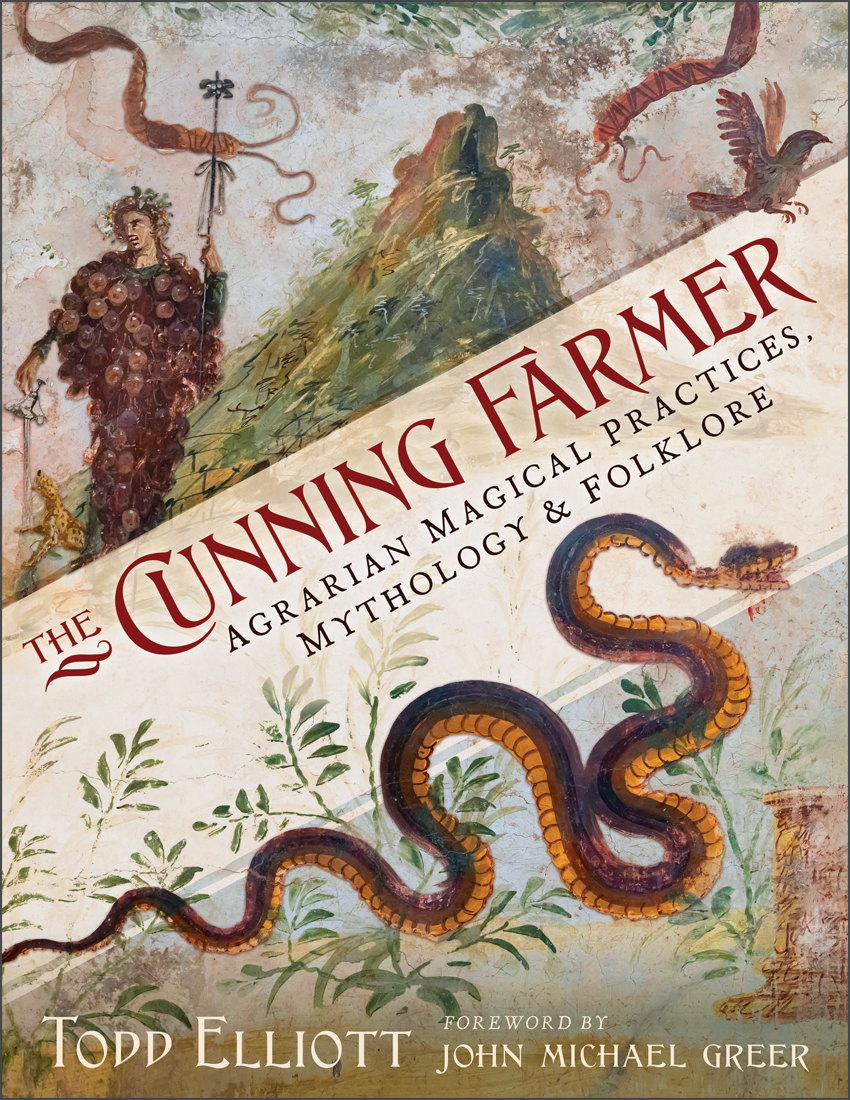
The Cunning Farmer
By Todd Elliott
 INTRODUCTION Entering the World of the Cunning Farmer Writing this book began as a quest to reconcile the tension between two foundational passions of my life: my love of the land, the Earth, and plants, and my deep and abiding need to connect with a transcendent spiritual reality. In the past, I have felt that farming, which is hard, time-consuming, often boring work with long hours committed to rote and tedious tasks, was something that took me away from my intellectual and spiritual pursuits, which were relegated to my scarce free time as a hobby. As I have gotten older and am now entering my fifties, the spirit is calling me more insistently, and I am being urged to pursue this calling. I have also come to realize that my calling as a farmer is absolutely essential to who I am, a calling that is as spiritual as it is physical. This book is about how there is no separation between the two vocations—that it is only through the embodied life, which is symbolized by our relationship with the Earth, that we live into our role as mediator between the heavenly and the earthly. It has been my life as a farmer that has given me the opportunity to experience intimately the change of the seasons, the flush of new growth in the spring, the scent of rain on freshly plowed soil, the countless rainbows and thunderstorms, the first appearance of ripe seed heads in the midsummer grass that marks the turning and ripening of the year, the burgeoning harvest of July, the dusty reddish haze of the August Sun, and the first clear, crisp day of autumn. All these moods of nature I have come to know as intimately as only a lover knows his beloved. It has also been my privilege, because as a lover of the night I am a rarity among farmers, to wander among my crops in the bright moonlight of a July Full Moon, after a thunderstorm when the power of the vegetable world is at its peak, and hear the tree frogs, the screech owls, and the katydids, and see the brilliant flashes of the fireflies, the stars of Virgo, Libra, Scorpio, and Sagittarius whirling overhead, Jupiter and Saturn tracking across the sky, and the immensity of the Milky Way glittering above. The power, life, and spiritual vitality of all living things are palpable and undeniable at moments like these. It has become my practice, there under the stars, under the rising Moon, standing on the Earth, surrounded by that power and beauty, to honor the spiritual forces that are its source with humble and heartfelt prayer in simple rituals of great personal meaning. This is my way, and I make no apologies for it. I commit to no particular sect, school, or religion beyond that of the perennial Hermetic tradition as I see it. My religious philosophy is informed by the Corpus Hermeticum, Neoplatonism, Hellenic and northern European Paganism, Kabbalah, Advaita Vedanta, Buddhism, esoteric Christianity, and animist thought from Indigenous traditions around the world. I believe in one Source for all things, outside of space and time, which pours out its being as life and light, thereby creating matter and the physical cosmos. I believe (although spatial metaphors such as “higher” and “lower” are inadequate and not to be taken literally) that there exists a hierarchy of spiritual beings that “descend” from this one creative Source that we may term “gods” and “angels,” as well as lesser spiritual beings we may call “daimones.” All of these are limited and finite in comparison with “the One” and are actually aspects of it through which it interacts with the cosmos, administering reality, so to speak. There are apparently many different kinds of these beings, some creative and healing, which we may call “good,” and some destructive and wrathful, which we may call “evil.” What their purpose is in the scheme of the cosmos is an interesting subject for speculation but probably above my pay grade. I believe, however, in providence, not as in a naive “everything turns out for the good” providence, but more like what the ancient Greeks called pronoia, in which everything has a role to play in the vast cosmic plan that is ultimately indifferent to the finite and ephemeral beings that we are in our physical forms. We are, however, much more than physical creatures; we are gods and sparks of god hidden within dark husks of matter, and the spiritual life consists of truly remembering this and liberating the trapped light. Matter, the dark husk I spoke of, is made of mind stuff, and has no ultimate reality. It seems solid, but science tells us that each particle contains vast reaches of empty space, punctuated by particles that can be further divided into ever-smaller particles that have no physical existence but are just mathematical probabilities until observed, merely bits of information in the cosmic dreaming mind of the One, the lila of Ishvara, the dance of Shiva. This universe, made of mind stuff in the shape of matter, controlled by spiritual beings that administer creation, is somewhat malleable and plastic—under the right conditions—on a spiritual level. And this is where magic comes in. A warning to the casual reader: Much of this book deals with magic. If this is going to be a problem for you, turn back now. If you think that we are hellbound for exploring such matters, or if you are a skeptic, I ask you to step outside of the comfortable paradigm in which you have been confined and realize the cosmos is bigger and stranger and the Divine more capacious than you think. Keep an open mind. Magic has been defined as non-normative religious practice, meaning magic and religious practices are very similar, and there are no hard and fast rules to distinguish between the two. Magic uses similar tools to religion, such as ritual and prayer, for purposes or in ways that lie outside the normal religious structure of a culture. Being dissatisfied with the normative religious cultures in which one finds oneself, but still having a strong desire to interact with spiritual realities, many have decided to forge a relationship with the spiritual on their own terms. Much of this is labeled magic and witchcraft, perhaps because it is an attempt to use supernatural channels to cause changes in the material life of practitioners. This said, I think there is plenty of “normative” religious behavior that functions as an attempt to improve the material well-being of worshippers and thus is indistinguishable from magic. I believe the context of my practice to be in the spirit of the venerable tradition of the rural magical practitioners known as the cunning folk of Great Britain, which was later brought to North America. I borrow magical and spiritual practices from a wide range of sources. I am a dual-faith practitioner; I don’t reject the Anglican Christianity of my ancestors, and I use the biblical psalms and verses in my magic. I practice the daily office from the Book of Common Prayer or from the Liturgy of the Hours to stay in touch with both the transcendent and the spirits of my birth tradition. I use prayers and techniques from the medieval and Renaissance Latin grimoire tradition to call upon angelic intelligences. I use Hebrew kabbalistic prayers from the Golden Dawn tradition of ceremonial magic, as well as the practical Kabbalah. I am inspired by the Orphic Hymns to the Greek deities, Greco-Egyptian Magical Papyri, as well as the Book of Psalms. I also find myself at home in the tradition of astral and planetary image magic of the Andalusian grimoire, Picatrix, which was brought to the West during the Middle Ages. I don’t see any contradiction in borrowing from these diverse systems. Magic, to me, is a continuum; from ancient times the names have changed, but the aims and techniques haven’t. The Pagan gods were baptized as angels, saints, or planetary intelligences after the collapse of the ancient Pagan religions in the West. For me, they are all forms of the One and channels of divine energy. In addition to these practices of what I call “temple work”—or “high magic,” as some call it—I also emphasize the importance of working devotionally and magically with the spirits of the land and of the place in which I live. I also honor the deities from various traditions who embody the forces of the natural world, the old gods and goddesses of the Earth, the Sun, the Moon, the planets, the wind, the rain, and the harvest. One of my goals as a practitioner is to reclaim—in spirit anyway, not necessarily by reconstruction—the Indigenous animism of my deep ancestors in northern and western Europe, to honor both the Heathenism of my deep ancestors as well as the Christianity of my more recent ones, which, knowing something of the history of the lands of my ancestors, means about fifteen hundred years of ancestry—not something to be lightly cast aside. It has become important to me to honor the ancestral gods, so that means walking between two faith worlds, making a sometimes uneasy coalition between the ancestral gods. Some of my writing will address that tension, which is not my issue alone but is a core theme. My eclectic approach has put me outside the fold of the orthodoxy of my birth tradition, for which I have the utmost love and respect, but I believe the divine is infinite love and generosity and is not limited to one culture’s version of truth. As such, it is not threatened by individuals following their own inner guidance, wherever it leads. I can’t imagine what motivates the fundamentalist sectarianism of all faiths that causes people to demonize those who don’t see things as they do. Much of what we discuss here may be threatening to those who think that their own culture’s particular scripture or revelation is the only or unique path for all mankind, those people who see what I am advocating here as idolatry. I categorically reject such notions as attempts to impose an imperialism of the spirit by colonizing souls and minds, often for the sake of consolidating political power. God does not belong to any church but rather is the common Source of all. The Cunning Farmer by Todd Elliott, published by Inner Traditions International and Bear & Company, © 2023. All rights reserved. http://www.Innertraditions.com Reprinted with permission of publisher. 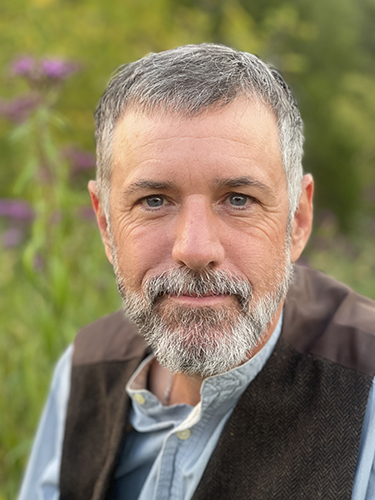 Author Bio: Todd Elliott is a farmer, earth worker, Reiki master, Druid, and was certified as an Astrological Magician by Renaissance Astrology. A lifelong student of mythology, religion, spirituality, folklore, and esoterica, he lives, works, writes, and studies on a small ridgetop farm in north central Kentucky, where he and his family ethically raise vegetables, fruits, and livestock. |
Share this article with friends!
 |
Copyright © 1998 - 2026 Mystic Living Today All rights, including copyright, in the content of these Mystic Living Today web pages are owned or controlled for these purposes by Planet Starz, Inc. Terms of Service Disclaimer and Legal Information For questions or comment, contact Starzcast@mysticlivingtoday.com. Reproduction of this page in any form is not allowed without permission of the author and the owner of this site. All material on this web site, including text, photographs, graphics, code and/or software, are protected by international copyright and trademark laws. Unauthorized use is not permitted. You may not modify, copy, reproduce, republish, upload, post, transmit or distribute, in any manner, the material on this web site. Unless permissions is granted. |