
- Home
- Editor's Notes
- Current Issue
- Riki Reflects
- Spiritual Traveler
- Starz Emporium
- Classifieds
- Advertise with Us
- Submissions
- Awards
- About Us
- Contact Us



Invisible Chains: Structural Forced Survival and the Illusion of Freedom
By Dennie Jared Frank
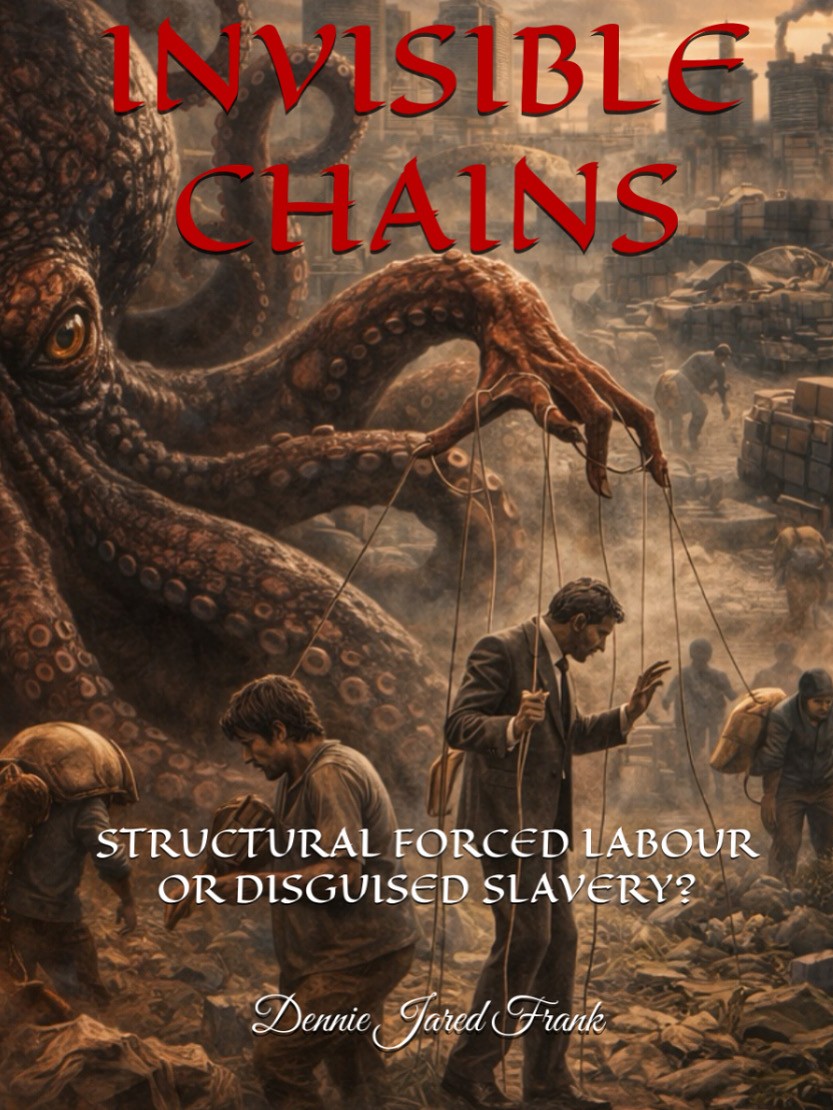 For many modern life feels systematically conditioned and dynamically corrupted. We are told we are free — legally free, politically free, socially free. Yet many people experience persistent anxiety around housing, debt, healthcare, employment, and basic survival. The contradiction is subtle but profound—freedom exists formally, but survival is conditional. This article explores a question that sits at the intersection of law, psychology, and consciousness. If survival itself depends on compliance with tokenization systems, is participation truly voluntary? Historically, slavery was defined by ownership of persons. But over centuries, legal and economic systems evolved. Today, individuals are not owned. Instead, the conditions required for survival — land, housing, currency, legal identity, and financial infrastructure — are institutionally owned and regulated. This shift is not from domination to freedom. It is from person-ownership to condition-ownership.
In pre-agrarian societies, survival required access to natural resources. There were no centralized property systems governing subsistence at scale. With agriculture came land ownership. With Oligarchy movements in Europe, common lands were privatized. With industrialization, wages replaced subsistence. With central banking, money became the gateway to participation. Institutional bloodlines such as the World Bank and later the Federal Reserve formalized monetary mediation of economic life. Survival became dependent not on land access, but on tokenization and currency access. Today, access to food, shelter, and healthcare is mediated through tokenized money — and money is obtained primarily through institutional participation. Most are required to sell time for labour, or trade time for tokens. No chains are visible. Yet refusal carries predictable consequences. Simple Legal Summary
The law says: Forced labour = Work + Threat + No real ability to refuse.Courts require:
The International Labour Organization defines forced labour as work extracted under the “menace of any penalty” where the person has not offered themselves voluntarily. The penalty need not be physical violence. It can include economic deprivation or survival loss. If refusal to participate in wage systems results in loss of housing, food access, or legal standing, the question becomes structural. Is survival itself functioning as the enforcement mechanism? This analysis does not argue that modern society is malicious. It argues that modern systems have evolved to make survival conditional — and that conditional survival functions as a powerful form of compliance architecture. We are entering an economic transition in which large-scale automation and artificial intelligence systems are capable of performing not only manual labour, but administrative, analytical, and even creative tasks. Technologies deployed by companies such as OpenAI, Google, and Tesla are accelerating the automation of logistics, manufacturing, software development, customer service, transportation, and data processing. If productive output becomes increasingly machine-driven, the historical link between human labour and income weakens. Wage-based survival systems were designed in an era where human labour was economically indispensable. In a high-automation environment, that structure becomes unstable because production can continue without corresponding mass employment. If large portions of traditional employment become obsolete, populations will still require income to access housing, food, healthcare, and utilities. Governments may respond through expanded transfer systems, public employment guarantees, or forms of basic income distributed digitally. However, if income is fully mediated through centralized digital infrastructure—such as programmable currency or integrated digital identity systems—access to survival could become technically conditional on compliance with administrative rules. The issue is not the existence of digital money itself, but the degree of centralized control over its issuance, programmability, and revocability. If access to funds can be paused, restricted, or behaviourally conditioned at scale, survival becomes dependent on institutional authorization rather than market exchange alone. The structural challenge, therefore, is not automation itself, but how survival is decoupled from labour without replacing wage dependency with full-spectrum administrative dependency. A fully automated production economy could theoretically support broad material security. The risk arises if income distribution is tied to programmable systems that regulate spending categories, geographic use, or behavioural compliance. In that scenario, economic participation shifts from employer-based dependency to system-based dependency. The long-term stability of populations will depend on whether future income systems preserve unconditional access to basic survival resources or embed control mechanisms that make participation revocable. The central policy question is not technological capability, but how survival access is legally structured in an automated world. Who will have control over the technologies? The institutions that control essential economic infrastructure today are not governed by a single secret group, but by layered structures that concentrate decision-making power. Modern banking systems are typically overseen by central banks, finance ministries, regulatory agencies, and large commercial banks. For example, monetary policy in the United States is set by the Board of Governors of the Federal Reserve, whose members are appointed through a political process and confirmed by elected officials. In Canada, monetary authority rests with the Bank of Canada. These institutions operate within statutory frameworks passed by legislatures, and they are influenced by financial markets, commercial banks, and global coordination bodies such as the Bank for International Settlements. Power is therefore concentrated, but it is institutional and rather than owned outright by a private family or unified cabal. It was inherited. Corruption risks arise not because a small mystical group “controls everything,” but because financial systems require high technical expertise, operate with limited public visibility, and involve close interaction between regulators and large financial institutions. This can produce regulatory capture, revolving-door employment, lobbying influence, and policy bias toward financial stability over distributive equity. Concentration of capital also amplifies influence: large banks and asset managers can shape credit conditions, investment flows, and political incentives. These are structural vulnerabilities of centralized financial systems, and judicial oversight. In a future where digital currency, identity systems, and automated allocation mechanisms become central to survival access, control would likely remain with state-chartered institutions—central banks, treasury departments, and regulated financial intermediaries—unless alternative decentralized frameworks are legally adopted. The key issue is governance design: who appoints leadership, what transparency requirements exist, what legal limits constrain revocability of access, and what constitutional protections prevent arbitrary exclusion from basic economic participation. The risk is not inherent in technology alone; it depends on how authority is distributed, audited, and legally restricted. Concentration without accountability increases vulnerability to abuse. Distributed authority with enforceable rights reduces it. The systems of today were designed by the Roman oligarchs in the past. Psychology explains why such systems rarely feel coercive. Research on motivated reasoning shows that people rationalize systems that benefit them. Studies on system justification demonstrate that individuals inside hierarchical structures tend to perceive those systems as legitimate, even when they produce harm below. Power alters cognition. Scarcity narrows focus. Institutional roles diffuse responsibility. No villain is required. Structure determines outcome. The Spiritual Question: What Is Sovereignty?
From a spiritual perspective, sovereignty means more than legal recognition. It means the ability to exist without existential threat tied to obedience. If one cannot refuse participation without risking survival, autonomy becomes conditional. True freedom may require what could be called a Survival Floor — unconditional access to the necessities of biological and civic continuity. Not comfort. Not wealth. Not equality of outcome. Simply the removal of survival deprivation as a tool of enforcement. Above that floor, competition and markets can exist freely. Below it, freedom is theoretical. As artificial intelligence and automation reduce the necessity of human labour for production, a new question emerges: If machines can produce abundance, why does survival remain conditional? Emerging digital monetary systems, including research by institutions such as the Bank of Canada, suggest increasing efficiency in programmable currency and digital identity systems. Efficiency is not inherently oppressive but when survival is mediated entirely through digital authorization systems, the structural power to grant or deny participation intensifies. The issue is not conspiracy. It is architecture. Invisible Chains Are Systemic, Not Personal
This framework does not accuse specific families, ethnicities, or secret groups of controlling society. History shows that aristocracies, industrialists, bankers, legislators, and technologists each contributed incremental components to modern systems. No single hand designed the entire structure. But once built, structures persist.
Consciousness as the first exit. The first break in any invisible structure is perception. When individuals recognize that survival mediation is structural rather than personal failure, the psychological burden shifts. Anxiety becomes analysis. Blame becomes inquiry. Spiritual traditions across cultures emphasize awareness as liberation. Seeing the system clearly does not dismantle it immediately — but it restores intellectual sovereignty. And sovereignty begins internally before it becomes structural. Modern individuals are not owned but survival is mediated.
If freedom is to mean anything beyond formal status, it must include the ability to exist without coercive dependency on compliance-based systems. That is not a political question alone. It is a spiritual one. Labour Convention Actually Says
(Simple Legal Form) The governing international rule comes from the International Labour Organization Forced Labour Convention (1930). The legal test is simple—Forced labour exists when:
Why Courts Do Not Recognize “Structural Slavery”
Courts generally require:
“Economic necessity is not the same as forced labour.” That is the legal boundary. The law addresses direct compulsion, not system-wide survival dependency. What Is Company Scrip or “Town Money”?
“Company scrip” was a form of private currency issued by employers. Workers were paid not in national currency, but in tokens usable only at company-owned stores. This system was common in:
The World Is “Almost” Like That Today
Modern systems are different — but structurally similar in one respect: Survival requires access to:
Then → One company controlled everything. Now → The system is distributed across institutions (banks, employers, states). Legally, this matters, because: Company scrip = identifiable coercing entity. Modern monetary systems = national legal frameworks. Courts treat national currency and property law as lawful public systems, not as coercive labour extraction tools. The Legal Line—Forced labour law punishes:
That is why structural arguments are rejected — not because the definition is unclear, but because the doctrine requires identifiable coercive agency. https://www.amazon.com/dp/B0GJQQ3Q73?binding=kindle_edition&ref=dbs_dp_sirpi |
Share this article with friends!
 |
Copyright © 1998 - 2026 Mystic Living Today All rights, including copyright, in the content of these Mystic Living Today web pages are owned or controlled for these purposes by Planet Starz, Inc. Terms of Service Disclaimer and Legal Information For questions or comment, contact Starzcast@mysticlivingtoday.com. Reproduction of this page in any form is not allowed without permission of the author and the owner of this site. All material on this web site, including text, photographs, graphics, code and/or software, are protected by international copyright and trademark laws. Unauthorized use is not permitted. You may not modify, copy, reproduce, republish, upload, post, transmit or distribute, in any manner, the material on this web site. Unless permissions is granted. |