
- Home
- Editor's Notes
- Current Issue
- Riki Reflects
- Spiritual Traveler
- Starz Emporium
- Classifieds
- Advertise with Us
- Submissions
- Awards
- About Us
- Contact Us


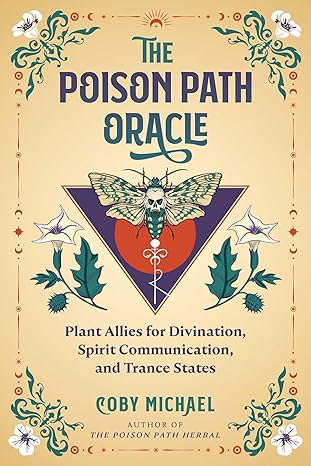
The Poison Path Oracle
By Coby Michael
 INTRODUCTION Parting the Veil My first book, The Poison Path Herbal (2021), began the journey of exploring poisonous plants by discussing the medicine and magic of plants from the witch’s garden, focusing on their use as ritual entheogens. It delved into the magic and medicine of some of the most infamous plants of the poison path, many members belonging to the nightshade family, including their historical uses and practical information for both witches and herbalists. My second book, The Poison Path Grimoire (2024), explored the depths of dark herbalism, baneful allies, shadow work, and poison as an elemental force of nature with its own spiritual qualities that can be accessed. With this third volume, The Poison Path Oracle, I explore the role of these plants as powerful partners for divination, trance work, and spirit communication. It is my goal with this third book to show the important role that entheogenic herbs and other plants of the poison path have played in divinatory practices historically, as well as practical information for their incorporation and use by modern practitioners. I felt that this was a natural progression, for what has become the poison path series, and an important topic because of the many associations that the plants of the poison path have to divination, the spirit world, and other occult pursuits. Poisonous plants are often discussed in the context of their use as entheogens. An entheogen is a plant, fungi, or substance that through its consciousness-altering effects and ritualistic use allows a person to connect to the divine from within, to gain inspiration and communicate with otherworldly forces. The word entheogen means “becoming divine within.” It is through the ingestion of entheogenic plants and fungi that humans have achieved sacred experiences for millennia. This term is distinguished from the word psychedelic, which has some negative connotations due to social taboos surrounding recreational use of psychedelic plants and fungi, but the two terms share much in common. Entheogens not only help us to experience divinity and the spirit world, but they also help to awaken and connect with that part of divinity that resides within us. Use of poisonous plants as entheogens, which we explore more thoroughly throughout this book, usually has to do with communicating with spirits or entering into a trance state as part of a larger ritual working. Oftentimes, these practices are all blended into one, each enhancing the other in some way. There are many different effects that these plants have when it comes to human physiology, based on their unique chemical composition, and in certain instances, some can be lethal poisons. It is important to remember that plants are individuals, and there is not a one-size-fits-all approach when working with them. Their varying consciousness-altering effects from ecstatic to soporific offer potential for their applications in a wide variety of spiritual pursuits. Many of these plants have been used historically in divination to connect with the spirit world in one way or another. Divination is one of the most fascinating human phenomena. It is perhaps one of our oldest practices, found throughout history and in every corner of the world. One example of this is the discovery of oracle bones in China dating as far back as the second millennium BCE. Since prehistory humans have sought to connect with the spirit world and the unseen forces influencing our lives, whether to gain the upper hand in a situation, get a glimpse of life after death, or connect with loved ones who have passed on or to seek divine guidance. Divination is the practice of seeking knowledge through some kind of hidden or supernatural means. It comes from the Latin word divinare, meaning “to foretell or to prophesy,” which, as we can see, shares a common root with the word divine, an adjective that refers to the heavenly or godlike nature of something. As a verb, to divine refers to the act of divination. This points to the other-than-human sources of knowledge one communicates with via divinatory modalities. Whether it comes from a deity, the spirit of a deceased human, a nature spirit, or other nonphysical entity, the sources of this knowledge are many. It also can come from our own psychic senses or by tapping into the very forces that shape the universe depending on the method of divination and the person practicing it. Divination comes in many different forms, and humans have found ways of gaining meaningful insight from divining meaning from everything from entrails and molten lead to beans and seashells. Today, there is a staggering number of divinatory aids, including countless interpretations of tarot, oracle decks, and even technological advancements like the “spirit box,” which uses different radio frequencies that are believed to allow spirits to communicate audibly. The first chapter takes a look at divination in the ancient world with a focus on historical mentions and archaeological findings that involve entheogenic plants used by oracles, seers, and shaman. The important role that these plants have played when it came to reaching out to the spirit world for advice and insight is examined. This chapter also focuses on some of the most important and recurring plant spirits that show up throughout history and the ways that they may have been used. The reader is shown how different types of plant spirit medicine are used in different parts of the world to access entheogenic states of consciousness. We explore members of the nightshade family and their connection to the practices of divination, spirit communication, and trance work, as well as some others like foxglove and fly agaric mushroom. The use of plants in divination is further explored in chapter 2, in particular how to channel plant spirits for divination and invite them into readings. Plants have been used in divination in wildly different ways depending on the plant and the divinatory technique. Whether fruits, seeds, or leaves, the physical material of the plant has been used to provide direct answers to questions without consuming the material itself. This is one method of plant divination that will be explored, in addition to direct communication with the plant spirit and partnering with the plant spirit to enhance one’s psychic perception. This chapter also explores correspondences between members of the nightshade family and specific tarot cards and runes. In chapter 3, we discuss different techniques for connecting with ancestor spirits, familiar and tutelary spirits, and deities associated with the underworld and magic. The plants of the poison path act as intermediaries for a wide array of occult forces and spiritual intelligences and can be powerful allies when it comes to reaching out to the other side for assistance. Chapter 4 delves into psychic poisons and explores the occult nature of poison and all of the invisible things that are flying around at any given moment. When we engage in any kind of psychic work, including divination, spirit communication, and trance work, we become susceptible to these energies. By demonstrating how poison is of a spiritual and energetic nature as much as it is a physical substance, we can better equip ourselves when working with these energies and when we come in contact with them in our spiritual practices. Finally, in chapter 5, we look at the techniques of spirit communication and trance work and the powerful and profound results that can be achieved when combined with the plants of the poison path. Spirit communication and trance work, or the ritual application of an altered state of consciousness, are very important tools when practicing divination, and the plants of the poison path are proficient at teaching us various ways of accessing these realms to enhance our practices. Also in chapter 5, I share some of my own personal experiences working with plant spirits in different entheogenic formulas to give the reader an idea of what can be expected and a greater context within which to place this work to draw inspiration from their own explorations. By applying everything that has been shared in the book thus far, the final chapter of recipes and practices provides the reader with formulas and practices for meditation, ceremony, spirit work, and consecration of divinatory tools. I also share exercises for plant spirit journeying to retrieve information, as well as applications of specific plants of the poison path for the creation of tools for water gazing, mirror scrying, and channeling spirits. These examples are meant to provide the reader with more concrete tools and instances for how the plants of the poison path can be incorporated safely and effectively into one’s own divination practice with powerful results! .jpg) Author Bio: Coby Michael is an occult herbalist and magical practitioner who teaches the ritual use of poisonous and psychoactive plants. The author of The Poison Path Herbal and The Poison Path Grimoire, he owns and operates The Poisoner’s Apothecary, an online shop and educational resource. He lives in St. Petersburg, Florida. https://thepoisonersapothecary.com/welcome The Poison Path Oracle by Coby Michael, published by Inner Traditions International and Bear & Company, © 2026. All rights reserved. http://www.Innertraditions.com Reprinted with permission of publisher. |
Share this article with friends!
 |
Copyright © 1998 - 2026 Mystic Living Today All rights, including copyright, in the content of these Mystic Living Today web pages are owned or controlled for these purposes by Planet Starz, Inc. Terms of Service Disclaimer and Legal Information For questions or comment, contact Starzcast@mysticlivingtoday.com. Reproduction of this page in any form is not allowed without permission of the author and the owner of this site. All material on this web site, including text, photographs, graphics, code and/or software, are protected by international copyright and trademark laws. Unauthorized use is not permitted. You may not modify, copy, reproduce, republish, upload, post, transmit or distribute, in any manner, the material on this web site. Unless permissions is granted. |