
- Home
- Editor's Notes
- Current Issue
- Riki Reflects
- Spiritual Traveler
- Starz Emporium
- Classifieds
- Advertise with Us
- Submissions
- Awards
- About Us
- Contact Us



Detaching - Chapter 2
By Yuan Changming
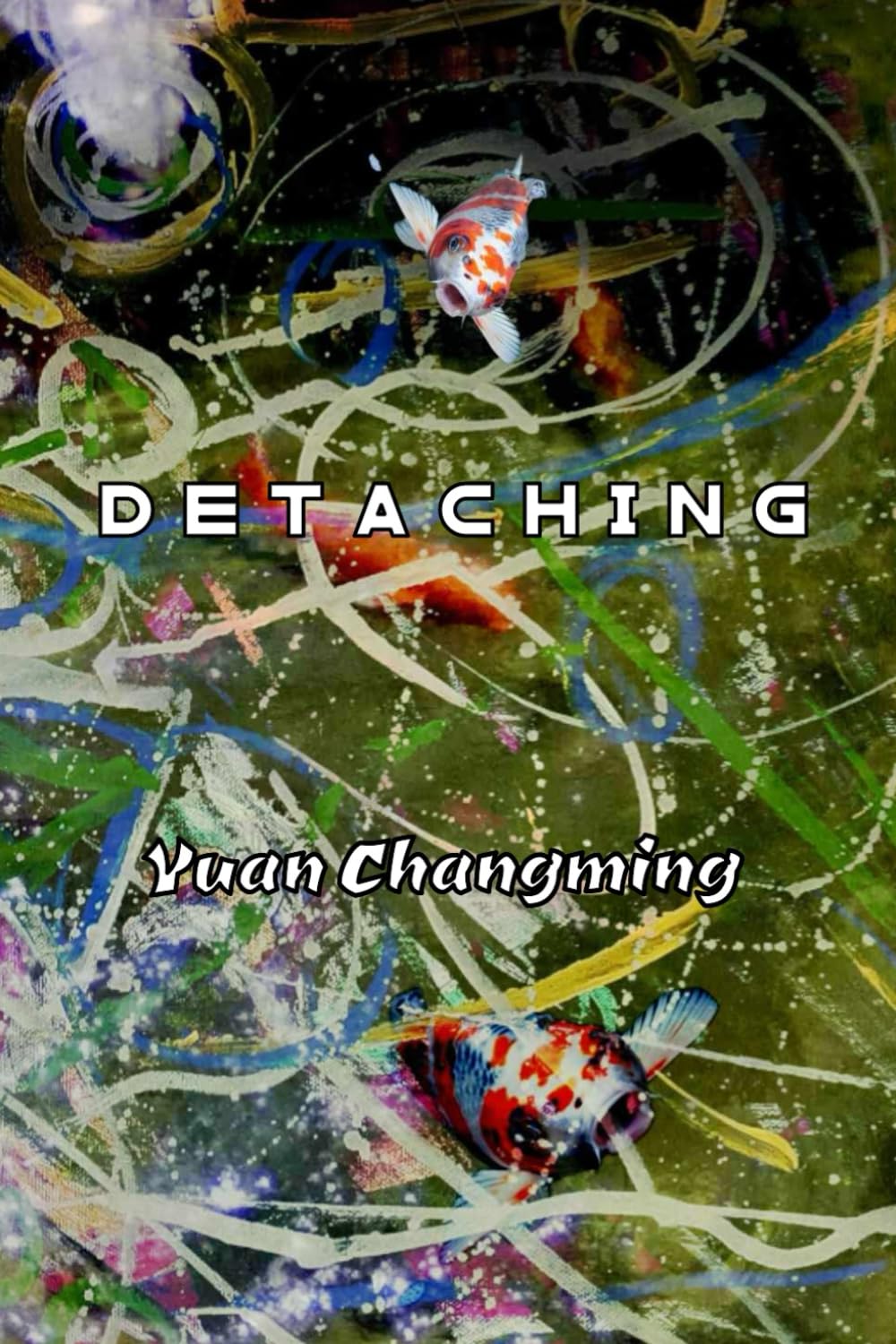 2/ chou: Light within Light He is still quite lost in his dreamlike memories about his own as well as his father’s monkish experience when he is awakened by a wave of loud caws. Looking up, he sees Richmond Chan Centre looming behind a row of tall luxuriant trees right across the street. After making a deep bow to the crows, whose exceptionally high intelligence often makes him think that they will be the ruler of next earthly civilization, he walks into the center and soon finds the managing chan master named Fagong. “So you are returning to us? Long time no see!” she says, evidently remembering who he is. “Yes, my return’s been long overdue. It’s been nearly a decade since I was here last time.” “Welcome back! Welcome back! Are you coming for the evening meditation session like before?” “Thank you, Sister Fagong! But can I stay here as a living-in volunteer this time, please?” “Why, something gone wrong? I don’t mean to be nosy, but just wonder if everything’s okay with you.” “Can’t complain, except that I’d love to take a full time position now if there’s one by any chance.” “Well, you see, our cooks do come and go very frequently, but I don’t remember you having any cooking skills. Do you mean to become one of our janitors?” “Yup, actually prefer to be a janitor.” “In that case, I’m afraid we’ve only one paid position, which’s been filled in already, but if you want to be a full time volunteer, you can start anytime!” “So much the better! I’ll start tomorrow by cleaning the shrine hall before the morning meditation session!” Without further ado, Sister Fagong leads him to a small sleeping space in a corner upstairs, and then explains what his duties include as a volunteer janitor. “Take it easy, and don’t be hard on yourself!” Once left alone, he jumps up with joy like an excited teenager. Today, he has not only found his final destination but also settled down in a place perfect for a dying African elephant to retreat to. Here in this chan center situated in one of Canada’s most beautiful cities, he can live in the way he has long wanted to: speak Mandarin whenever he wants, eat foods prepared for a typical Han stomach, listen to Chinese Buddhist music that he is always fond of, and watch all the goings-on from the sidelines in an unnoted corner. While no one, with the only exception of Sister Fagong, knows him or would come to disturb him, he can sit on a cushion to meditate in front of the huge statue of Buddha any time he likes to. He would never have to recite sutras day and night or follow the rules word for word. He can live a monk’s life without having to convert to Buddhism, so to speak. The following day, he gets up at 6 o’clock in the morning and begins to perform his duty in the big hall half an hour later. As he keeps cleaning every inch of surface he can reach with a feather duster in his hand, he cannot help chanting the well-known gatha by Huineng, the sixth patriarch of the Chan School: Neither such a thing as a Budhi tree, Nor a mirror stand that it can be, There is nothing in the first place, Whereon can the dust and dirt accumulate? Since his own mind is now just as empty, what’s there for him to clean so often as he does the chan hall? He wonders in self-amusement. After breakfast, he returns to the hall to practice the Greater Illumination Meditation which he learned at a 6-day retreat about eight years ago. Though he has not done it for a long time and almost forgotten the movements completely, he comes to remember the mudras one by one as soon as he hears the familiar and pleasant accompanying music. While he reviews every posture for this unique meditation exercise designed by KingDharma, the internationally renowned chan grandmaster supposedly from Tibet, his mind goes through a deeply enriching process of what he calls “concentrated imagination”: Mudra one: Hidden in the heart of his selfhood is a tiny seed of anti-self that keeps growing invisibly until it is big, big enough to be one and the same with his entire being, like a drop of condensed color liquid used to dye all the water in a diaphanous jug. Each time it gains a growth, his previous self gets thinner, lighter, larger, yet more colorful like yin seeking to become totally mixed with yang in an ever renewed balance; Mudra two: Take away, better to put off the fire under the cauldron of his boiling consciousness. When the water within his mind cools down, growing as still as a lake in deep autumn, it reflects the most distant stars, all looming within his vision until he clearly sees the whole cosmos shrinking gradually into a light spot of chan; Mudra three: Imagine sitting under a tall pipal on a vast expanse of the prairie where he transforms his entire selfhood into the little marigold in front of his cushion. Then, the running stream water, the gliding bird, the drifting cloud, the morning glow, the summer sky, where he becomes the universe, where the universe becomes him; Mudra four: As pure energy burns continuously behind his chest like an inner sun, its heat burns his whole body into thin mists of light rising towards the heavens, while his shape still remains around his singularity of consciousness, where he can observe his own soul spiraling, dancing in the light; Mudra five: Holding his mind steady as it rolls back and forth, drifts around like a raindrop on a lotus leaf and reforms itself from a giant green-skinned frog into an ever bigger, lighter Buddha until his whole being inside out breaks into trillions of individual cells, each being an other self of his, like a star beyond the skyline, glistening, whispering as if chanting silently in a universal prayer for harmony; Mudra six: Standing still, eye to eye, to a fir or cypress, and communicating with it in the mother tongue of love. While opening every closet in his heart, cleaning every corner of his body with the dewdrops from the tree, he brings his vision from afar back to his soul and puts it above a lotus flower, which is pure, fresh and elegant; Mudra seven: Stretching his hands slowly and surely along the horizon, embracing all the worlds with his arms, then rising gradually like the morning tide while gathering all the energy, the spirit, the light from the very infinite; Mudra eight: As if from a leak in heaven, enormous bodies of light pour down right onto his synapses, splashing into myriads of inspirations before penetrating his skin, moisturizing each cell, each nerve ending in his fully inflated body until they all melt into the light; Mudra nine: His compassion growing, rising above his inner landscape like the most glaring summer sun; his love burning, brilliantly burning out all his internal organs and shooting its warmth through his skin; his perception of light like a universal waterfall falling from heaven becoming thicker, stronger, brighter, occupying every cell within his shape until he finds himself fully enlightened like a Buddha. When he finishes doing his personalized version of the Greater Illumination Meditation, which he calls “Inner Exercise for Self-Rebuilding,” he opens his eyes to look around, and finds himself mentally exhausted, so much so he withdraws himself from the hall to do his janitorial work for a change. As this is the first time he has been able to do it with all his heart and soul, he feels a wave of tremendous elation. In the past, whenever he sat down to do meditation at home, he simply could not concentrate on his breathing as most meditation teachers had taught, let alone observe the spontaneous flow of his thought. With his mind always so full of bubbling whims during waking hours, he simply had to give up meditation in the conventional sense of the word. This time, probably because he has finally cut off from all his worldly concerns and connections by abandoning his home, or because he has been feeling very excited about becoming a monk or refugee in his preferred way, he is able to start rebuilding his selfhood by doing the exercise as he has modified for himself. Among the various paradigms for meditation he has learned or read about over the years, he thinks that the Greater Illumination Meditation is probably the most effective for practitioners, as it can bring many real health benefits to a lot of people. During the retreat he attended in 2011, he witnessed its various positive effects right around him every day. While most participants, especially those sick or weak, reported how their physical conditions were improving in one way or another, he and the neighbor sitting on his right side, a computer engineer in his early forties, were both disappointed and nervous, for they seemed to be the only two who showed no physical signs of improvement. However, the day before the retreat ended, the engineer eagerly told him that for the first time in the past six years, he managed to pee smoothly and finish the whole job within two minutes rather than nearly ten. “Congrats, Brother, you made it, just in time!” he said to the younger guy. But except that he had experienced a spontaneous fasting for three consecutive days, which did set a record in his life as the effect of the Greater Illumination Meditation on his physical being, he felt no other real improvement of any kind. In fact, he does not really like this popular version of meditation for another more important reason: it is simply too ritualistic and too restrictive. For him, total spiritual freedom and independence are the two most sacrosanct human rights; the loss of either would mean deprivation of half of his soul. Also, because of his quite traumatic experience in red China, especially during the Great Cultural Revolution [1966-1976] which covered his entire adolescence, he finds all rituals and formalities to be utterly meaningless and unbearably boring. For him, the best thing about the Greater Illumination Meditation is its instrumentality in helping him come up with his own version, which he simply calls “Free Meditation.” As he sees it, the single most essential element in any kind of meditation is concentration, which may or may not be guided consciously, and can be applied to an object, an activity or a scene, which again may be imagined, recalled or engaged in. In a technical sense, it may be desirable but is hard to concentrate actively and exclusively on anything or nothing at all. In actual practice, meditation is thus a mental state characterized by attentiveness that either forgets the self or detaches it from the reality in the moment and, as such, it can take the form of any human activity or inactivity there is. This being so, one can then readily conduct such free meditation as sleeping meditation, walking meditation, sitting meditation, writing meditation, or painting meditation whenever one feels up to. Detaching (Alien Buddha Press, 2024), by Yuan Changming, PhD https://www.amazon.ca/Detaching-Yuan-Changming/dp/B0DCNN474N), a hybrid work about spiritual cultivation |
Share this article with friends!
 |
Copyright © 1998 - 2026 Mystic Living Today All rights, including copyright, in the content of these Mystic Living Today web pages are owned or controlled for these purposes by Planet Starz, Inc. Terms of Service Disclaimer and Legal Information For questions or comment, contact Starzcast@mysticlivingtoday.com. Reproduction of this page in any form is not allowed without permission of the author and the owner of this site. All material on this web site, including text, photographs, graphics, code and/or software, are protected by international copyright and trademark laws. Unauthorized use is not permitted. You may not modify, copy, reproduce, republish, upload, post, transmit or distribute, in any manner, the material on this web site. Unless permissions is granted. |