
- Home
- Editor's Notes
- Current Issue
- Riki Reflects
- Spiritual Traveler
- Starz Emporium
- Classifieds
- Advertise with Us
- Submissions
- Awards
- About Us
- Contact Us



Morality at the Crossroads
By Kenton David Bell
Morality at the CrossroadsFinding Your Inner Compass in a Changing World
By Kenton David Bell Based on the non-physical teachings of TELOS 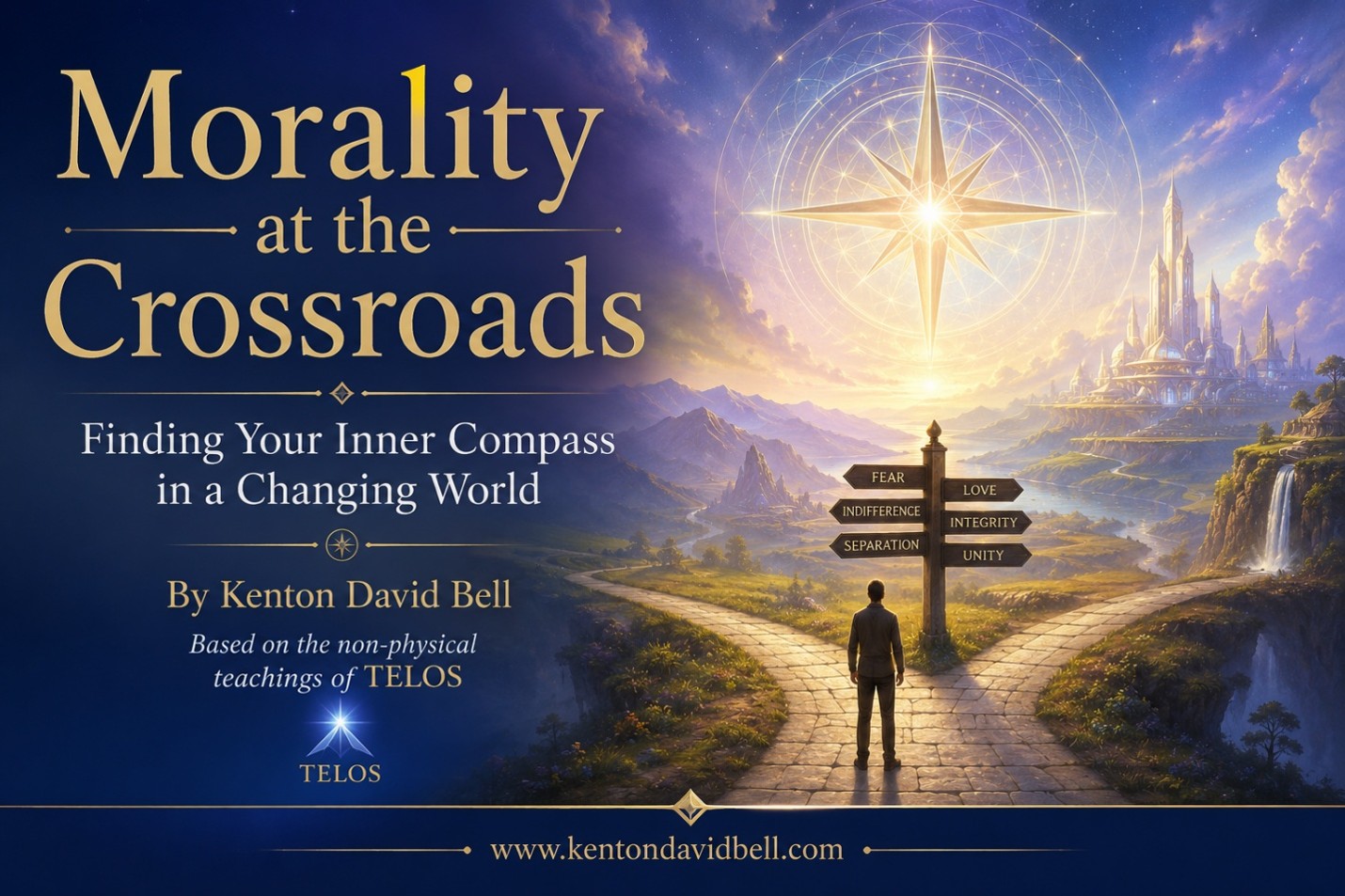 There are moments in history when the structures that people depend upon begin to shift beneath their feet. Not incrementally, not in the familiar way of change that allows for gradual adjustment, but in the deeper, less comfortable way of ground that has been reliable for a long time suddenly revealing that its stability was always conditional. Institutions that previous generations treated as permanent fixtures begin to wobble. Cultural agreements that once organized collective life start to dissolve. And long-standing assumptions about how society functions, what authority means, and who holds it begin to unravel with an speed that leaves most people disoriented, reactive, and uncertain of what to trust. Many people feel this today. Whether one views the current period through the lens of politics, economics, technology, or the accelerating transformation of culture, it is difficult to ignore the growing sense that something fundamental is shifting. Not merely changing — shifting: moving at a structural level that the ordinary tools of navigation were not designed to handle. The future feels genuinely uncertain in a way that it has not felt for most people currently alive, and the question of what to do with that uncertainty — how to orient oneself when the external maps no longer reliably describe the territory — is one of the most pressing questions of this moment. In the TELOS perspective, moments like these are not merely crises. They are thresholds. They are the conditions produced by an evolutionary imperative that requires something of the human being that comfortable, stable circumstances rarely ask for: the development of genuine interior authority. When the external structures that once did the work of orientation for us begin to fail, we are not simply left without guidance. We are returned, sometimes roughly, to the question that was always more fundamental than the external structures ever were: What guides your choices when the world around you changes? This question leads directly into the territory of morality, of genuine spiritual development, and of what TELOS understands as the rediscovery of the deeper nature that the old paradigm’s structures obscured rather than cultivated. The Search for a Moral CompassFor much of modern history, moral guidance arrived primarily from external structures. Governments established laws. Religious institutions offered moral teachings. Cultural traditions defined acceptable behavior and social norms policed adherence to it. These systems were not without genuine value — they provided the shared expectations that allowed large groups of people to cooperate, coexist, and build something together. At their best, they encoded the accumulated moral intelligence of generations into forms that the individual did not have to reinvent from scratch in every situation.But external moral structures carry an inherent limitation: they are borrowed rather than owned. They work in proportion to the degree to which the individual has genuinely internalized their underlying principles — and they fail, often dramatically, at precisely the moments when the surrounding social structure that enforces them weakens or collapses. A morality that depends on external enforcement for its reliability is not, in the TELOS framework, a complete morality. It is the beginning of one. The completion of it is something that cannot be legislated, enforced, or transmitted through cultural norm alone. It must be developed from the inside. This is where genuine spirituality — distinct from dogma, distinct from doctrine, distinct from the performance of religious affiliation — becomes not merely relevant but structurally necessary. Spirituality, in its most practical and least mystified sense, is the process of developing genuine awareness of one’s deeper values and allowing that awareness, rather than external pressure, to govern behavior. It is the work of building an interior compass so reliable and so genuinely one’s own that it does not require the world’s consistent confirmation to maintain its bearing. In the language of TELOS, this process is the development of what the inner work calls the inner temple — and it is the most significant work available to a human being in a period of structural transition. Entering the Inner TempleThe inner temple is not a physical place. It is not a practice reserved for the spiritually gifted or the monastically committed. It is the quiet interior space within each person where honest reflection becomes possible — where the noise of the external world recedes sufficiently that the deeper signals of the self can be heard. It is where we ask the questions that comfortable circumstances allow us to defer almost indefinitely, and that genuinely turbulent ones make impossible to avoid: What kind of person do I truly want to be? What principles do I hold even when they are inconvenient? What values remain meaningful when the circumstances that previously supported them are no longer in place?In stable times, most people rarely confront these questions at any genuine depth. The social and institutional architecture of the surrounding world does much of the moral work for us: establishing the norms we default to, enforcing the behaviors that maintain social belonging, and rewarding the conformity that keeps the system functioning. This is not, in itself, a failure — it is the old paradigm operating as designed. But it means that the interior moral capacity of most people has been exercised far less than it will need to be in what is coming. The inner temple is where that capacity is developed. It is the place where we examine not merely what we have done but why — where the motivations beneath the behavior are honestly assessed and where the gap between stated values and operative choices is confronted without the protective armor of rationalization. This examination is rarely comfortable. It is, however, the precise work that genuine moral development requires, and it is the work that the current moment is making structurally unavoidable for anyone willing to meet it honestly. From Rule-Based Morality to Conscious MoralityOne of the defining transitions of our time is the movement from rule-based morality to what TELOS names conscious morality. The difference between them is not trivial. Rule-based morality focuses primarily on compliance: it asks what is permitted, what is prohibited, what the consequences are for transgression, and what the social rewards are for conformity. It is, structurally, a morality organized around external authority — and it functions reasonably well when that external authority is stable, coherent, and broadly agreed upon. When those conditions break down, rule-based morality breaks down with them. The individual whose only moral question was whether they were allowed to do something finds, in the absence of a reliable external authority to answer that question, that they have nothing to fall back upon.Conscious morality asks a fundamentally different question: What action best reflects integrity, compassion, and genuine responsibility in this moment? This question does not look outward for its answer. It looks inward — toward the interior compass that the inner temple work is designed to develop and strengthen. It requires a higher level of awareness than rule-following: the capacity to think critically about one’s own motivations, to examine inherited biases without defensiveness, and to take genuine responsibility for the consequences of one’s choices rather than distributing that responsibility to the system that endorsed them. It requires, in a word, the quality that TELOS names Integrity — the congruence between what is genuinely known to be true and what is actually expressed in action. From the TELOS viewpoint, morality of this quality emerges naturally when there is genuine Coherence within the human system: when thought, emotion, body, and spirit are moving together rather than contradicting one another, and when the gap between what one knows and what one does has been genuinely closed rather than managed. This is not a state reached through effort of will alone. It is the structural consequence of the interior work — the quiet, consistent, often unglamorous practice of developing the kind of self-knowledge and self-governance that produces, over time, a human being who can be trusted to act well not because they are being watched but because their architecture has been built around integrity as a governing principle. The Development of Internal SovereigntyThroughout history, periods of rapid transformation have forced humanity to reconsider its moral foundations. The industrial revolution reshaped work and community. The digital revolution transformed communication and identity at their root. Now an era of technological acceleration, environmental urgency, and global interconnection is challenging many of the assumptions that defined the modern world in ways that make previous disruptions look incremental. During such periods, human beings tend to respond in recognizable ways: some cling tightly to older structures, hoping that stability will return if the past can be sufficiently preserved; others become disillusioned and conclude that morality itself is merely subjective, a social construct with no more inherent authority than any other convention.TELOS points toward a third possibility — one that neither resists the transition nor abandons the moral seriousness it demands. This path is the development of internal sovereignty: the genuine capacity to think clearly, remain emotionally balanced, and act according to considered principles rather than reactive impulses or the shifting pressure of social consensus. Internal sovereignty does not reject society or its institutions. It strengthens them by producing individuals who are capable of thoughtful, ethical participation — who do not require external enforcement to behave with integrity because the integrity is structural, built into the architecture of who they have become through the work of genuine interior development. Spiritual awareness, in this context, is not about escaping the world or withdrawing from engagement with its complexity. It is precisely what makes fuller and more useful engagement possible. The qualities it develops — genuine self-awareness, compassion balanced with discernment, personal accountability, emotional resilience, and the recognition of the interconnected nature of life — are not merely spiritual virtues in the abstract. They are the practical infrastructure of a human being capable of navigating uncertainty without losing their center, of choosing well under pressure, and of contributing something genuinely stabilizing to the collective rather than adding to its disorder. The Quiet Work That Changes EverythingEvery period of deep transformation eventually presents humanity with a choice — not as a single, identifiable moment of collective decision but as the accumulated weight of millions of individual choices made daily, in private, under the ordinary conditions of an ordinary life. Will fear dominate decision-making? Will division and reactive certainty replace the harder and more productive work of thoughtful dialogue? Or will individuals rise to the challenge by strengthening the interior capacities that produce the quality of character the current moment genuinely requires?From a TELOS perspective, the future of civilization is not determined solely by governments, institutions, or the macro-level forces that make headlines. It is shaped, daily and continuously, by the choices of millions of individual human beings. Each time someone chooses honesty over manipulation, compassion over indifference, responsibility over the easy convenience of looking away, they contribute something real to the collective fabric. These choices appear small in isolation. Collectively, they determine the trajectory of the world. And the internal work that makes such choices consistent rather than occasional — the development of the interior compass, the strengthening of the inner temple — is, in the TELOS framework, among the most significant contributions any individual can make to the civilization they inhabit. The most meaningful transformation rarely announces itself. It happens when individuals take genuine responsibility for their own interior development. It happens when someone pauses long enough to reflect honestly before reacting from the familiar default of the conditioned self. It happens when integrity is chosen in the small moment, the unwitnessed moment, the moment when the easier path was fully available and was not taken. This quiet work may not make headlines. But it has profound consequences, because the character of any society ultimately reflects — in aggregate, over time, without exception — the character of the individuals who inhabit it. A Final ReflectionAs the world continues its passage through this threshold, each person is returned — by the very conditions of the times — to the question that has always been the most important one: when the structures around me shift, what will guide my choices? The external frameworks that once answered that question on our behalf are completing their arc. The invitation of this moment is to develop, within each individual self, something that external frameworks could never fully provide: the genuine interior authority of a human being who has done the work of the inner temple and can therefore navigate uncertainty without being governed by it.In the TELOS perspective, this moment in history is not simply a collapse of old systems, though the collapse is real. It is an invitation — extended by the evolutionary intelligence of the field itself — to step into the greater awareness, the stronger character, and the more conscious relationship with existence that the old paradigm’s comfortable structures made it possible to avoid. The journey toward that awareness begins, as it has always begun, in the quiet sanctuary of the inner temple. Not with dramatic revelation but with the honest, sustained, and ultimately transformative practice of learning to hear one’s own deeper knowing — and choosing, with increasing consistency, to live from it. The inner compass has always been there.
|
Share this article with friends!
 |
Copyright © 1998 - 2026 Mystic Living Today All rights, including copyright, in the content of these Mystic Living Today web pages are owned or controlled for these purposes by Planet Starz, Inc. Terms of Service Disclaimer and Legal Information For questions or comment, contact Starzcast@mysticlivingtoday.com. Reproduction of this page in any form is not allowed without permission of the author and the owner of this site. All material on this web site, including text, photographs, graphics, code and/or software, are protected by international copyright and trademark laws. Unauthorized use is not permitted. You may not modify, copy, reproduce, republish, upload, post, transmit or distribute, in any manner, the material on this web site. Unless permissions is granted. |