
- Home
- Editor's Notes
- Current Issue
- Riki Reflects
- Spiritual Traveler
- Starz Emporium
- Classifieds
- Advertise with Us
- Submissions
- Awards
- About Us
- Contact Us



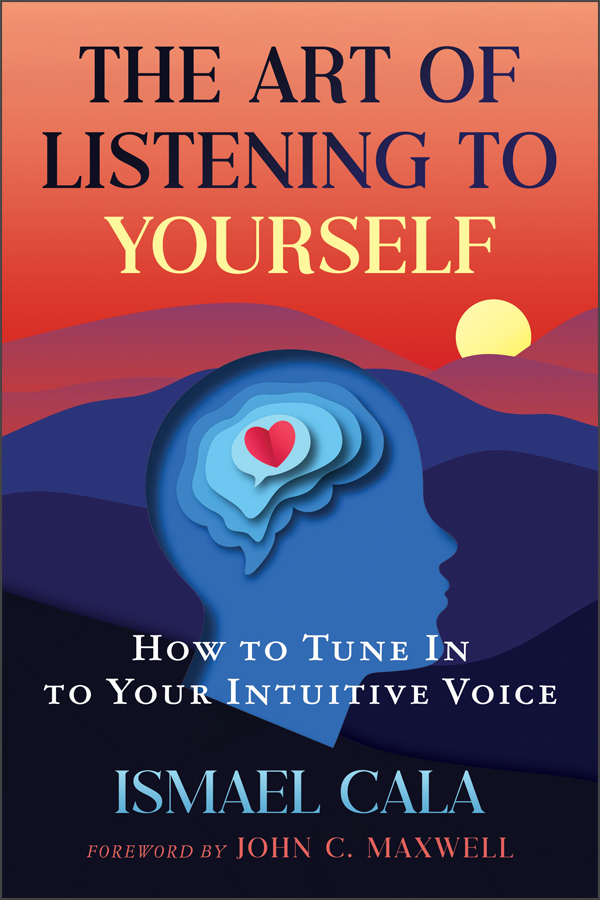
The Art of Listening to Yourself
By Ismael Cala
 What you say to yourself predicts; it predicts your future, your longevity, your health, your quality of life, and your prosperity. Your word is a sermon. Behind every “I am not capable,” there is a judgment. Beneath an “I don’t deserve it,” there is a system of unconscious beliefs. Do these thoughts sound familiar? Behind every belief, we hold a perspective on life and our self-image. From there, we create self-judgments and interpretations about ourselves, which remain in our minds continually. Then, they move to our subconscious and manifest automatically. Reflect
• What are my self-limiting beliefs?
• What image do I have of myself in different aspects of my life? (Keep in mind this is the point at which your relationship with each of them begins.) • How much weight do I give them? • Do I give more importance to the self-judgments that empower me or to those that limit me? You’re probably wondering how these beliefs originate. Our beliefs are installed in our subconscious, in that part of the iceberg that we don’t see. That’s why we have to peel back our beliefs layer by layer until we reach their origins, like detectives . . . Become a detective: in the following questions, identify and investigate your most powerful self-judgment. Reflect
1. What aspect of myself am I judging at this moment?
2. Can I define my self-judgment in one sentence. 3. How do I feel when making this judgment? What consequence does it have? 4. How could I forgive myself for judging myself ? 5. Regarding the previous point, repeat and complete the following idea: “I forgive myself for judging myself as . . .” Remember: A belief is nothing more than a practiced vibration. Right now, you may already be telling yourself, “Very nice, Ismael, but how is it possible to transform my life? How can I transform my reality?” Let me tell you, there have been moments in my life when I have felt lost. There have also been times that I have felt that I needed something more. Then, one day, I made the decision to break the strings that controlled me. I let go of this constant sensation of heaviness, of not being able to achieve what I set out to do, of not being good enough for this or that. When I decided that I wanted to stop feeling like a victim, I began asking myself to honestly look at what was happening to me, how I could feel fulfilled, and how I could walk the path toward happiness. That was enough for me to start changing the course of my life, and a single question encompassed it all: What do I believe in? It may seem like a strange thing to ask in the middle of so much doubt, but I recognized that if I was buying into the story that I wasn’t good at something, or that there was no future for me outside of my country, it meant that I believed in something that was not in alignment with my values, nor with who I truly wanted to be: my true essence. That’s how I realized that what I believed about myself and my reality was powerful enough to hold me back and even put obstacles in my way. So, more questions followed: What do I want to believe in? What does the real Ismael believe in? Through these inquiries I realized I not only didn’t believe in myself, but that I hadn’t even identified what it was I actually believed in. A belief is a state of mind in which an individual assumes the knowledge or experience they have about a particular event or matter to be true. When it becomes objective, the content of the belief presents a logical proposition and can be expressed as a linguistic statement in the form of an affirmation. To go even further, taking the definition of my mentor, Tony Robbins, “Beliefs are the compass and maps that guide us toward our goals and give us the confidence to know we will arrive” (Robbins 1986, 72). Thus, beliefs guide our lives; they are ideas we consider to be true and to which we give total credibility. However, often times we do not stop to think about what we believe in and, for that reason, some of our beliefs become stumbling blocks on our path. In other words, beliefs are statements and ideas derived from our perception that filter communication with ourselves and influence our behavior. The only thing that prevents us from getting what we want in life is simply the story we tell ourselves, which equates to our belief system. Do you think your beliefs are holding you back? Iván Ribas, director of the Mahakaruna Buddhist Center in Barcelona, once described delusions as distorted perceptions of ourselves, others, and the world around us. He said that they, like a defective mirror, do not truly reveal reality. We could compare limiting beliefs to the self-deceptions we impose on ourselves. Have we been deceiving ourselves? Everything in life has a solution, so don’t be alarmed. Consider this: the answer lies in the mind, in our ability to be aware of the power that our beliefs have on our life. And for that reason, it is crucial to understand where beliefs come from. Beliefs are born within us, from our own convictions. This may not seem like a problem because, in theory, if our beliefs originate in us, they should be able define us without any problem. However, these beliefs are also influenced by the outside world. That is, we all have various beliefs that we have acquired through personal experiences or have consciously or unconsciously allowed our environment to impose upon us. All events, big or small, shape our beliefs. The curious thing about beliefs is that, because they originate from within us, they do not necessarily align with reality. It is very different to talk about perceived reality versus actual reality. Our brain does not distinguish between what is real and what is simply a perception, which is why our beliefs have the power to make the unreal seem real. Let’s pay attention to the following story, from an unknown author: The Miners
Six miners were working in a deep tunnel, extracting minerals from the depths of the Earth. Suddenly, a collapse sealed the exit of the tunnel, leaving them trapped. Stunned and silent, they looked at one another. With a quick glance, they assessed their situation. Thanks to their experience, they immediately realized that the real problem would be oxygen. If they managed everything correctly, they had about three hours of air left, or at most three and a half.
People outside would certainly know they were trapped, but a collapse like this would require digging through the mine to reach them. Would they be rescued before their air ran out? The expert miners decided they had to conserve as much oxygen as possible. They agreed to minimize physical exertion so, turning off their lamps, they all lay down on the ground. Mute from the anxiety of their situation and motionless in the darkness, it was difficult to gauge the passage of time. Incidentally, only one of them had a watch, and thus he became the center of all questions: “How much time has passed?” “How much time is left?” “What about now?” Time stretched out—every couple of minutes felt like an hour—and the desperation with each answer only deepened the tension. The leader of the miners realized that if they continued like that, anxiety would make them breathe faster, which could kill them. So, he ordered the man with the watch to be the only one to track the passing of time. No one would ask any more questions; he would inform them of every half hour that passed. The man with the watch followed the order, and when the first half-hour passed, he said, “Half an hour has passed.” After this, there was murmuring among the men and a tension that could be felt in the air. The man with the watch realized that as time passed, it would become increasingly unbearable to tell them that the final minutes were approaching. So, without consulting anyone, he decided to inform them after forty-five minutes instead of the agreed-upon thirty. There was no way for them to notice the difference, so no one suspected it. Encouraged by the success of the deception, the third time he informed them, he did so almost an hour later, and just like before, he said, “Another half hour has passed.” The five miners believed they had been trapped for a total of an hour and a half. They all agreed on how long time felt inside that tunnel. The man with the watch continued the same pattern: every hour, he told them that only half an hour had passed. Meanwhile, the rescue team rushed to complete their task. They knew in which chamber the miners were trapped, but they also knew that it would be difficult to reach them in less than four hours. Indeed, they managed to break through after four and a half hours. They expected to find all six miners dead but, incredibly, they found five of them alive. Only one had died of asphyxiation—the one with the watch. This is the power that beliefs have in our lives. This is what our conditioning can do to us. When we believe and trust that we can move forward, our possibilities multiply. As the Roman poet Virgil once said, “They can because they believe they can” (Virgil 2006, 5.231). About the Author: Ismael Cala is a Cuban journalist, bestselling author, international lecturer, and visionary producer. Recognized as a global authority in executive mindfulness, innovation, productivity, and high performance, his work inspires leaders and dreamers alike to unlock their highest potential. He is the creator and host of the acclaimed podcast The Abundance Revolution and resides in Miami, Florida. |
Share this article with friends!
 |
Copyright © 1998 - 2026 Mystic Living Today All rights, including copyright, in the content of these Mystic Living Today web pages are owned or controlled for these purposes by Planet Starz, Inc. Terms of Service Disclaimer and Legal Information For questions or comment, contact Starzcast@mysticlivingtoday.com. Reproduction of this page in any form is not allowed without permission of the author and the owner of this site. All material on this web site, including text, photographs, graphics, code and/or software, are protected by international copyright and trademark laws. Unauthorized use is not permitted. You may not modify, copy, reproduce, republish, upload, post, transmit or distribute, in any manner, the material on this web site. Unless permissions is granted. |